Cleantech talent energizing Finland’s sustainable future
Finland’s commitment to sustainability is well known. But the newest TechSkillsAtlas™ 2026 reveals just how deeply that commitment is embedded in the country’s skills base. Cleantech is one of the country’s most dynamic technical fields, backed by a young workforce, strong science, and a wide regional presence.
Cleantech is the umbrella term for technologies that help reduce emissions, conserve resources and accelerate the transition to a low‑carbon and increasingly regenerative future. And Finland is already playing a major role.
“Finland is one of the world’s most committed countries to carbon reduction and climate change mitigation,” notes Michel Lemagnen, CEO of MCJ Lemagnen Associates – the firm that designed and conducted the TechSkillsAtlas™ 2026 study. “Its Cleantech workforce reflects that commitment in scale, youth and adaptability.”
Cleantech’s untapped resource
One of the most striking findings of the 2026 study is the scale of Cleantech expertise that sits outside the current workforce. In addition to the active talent base, Finland has 93,000 people with Cleantech skills who not presently working in the sector, along with 13,000 unemployed professionals whose capabilities remain highly relevant.
Rather than signaling decline, this represents a major opportunity: a reservoir of scientifically trained professionals whose skills can be reactivated as the sector grows. “A substantial share of lapsed technical professionals are interested in returning to technical roles. That’s an important opportunity for employers,” says Lemagnen.
At a time when global sustainability sectors face acute skills shortages, Finland’s combination of active and dormant talent offers a rare competitive edge.
A young workforce with interdisciplinary strength
Cleantech in Finland includes 67,000 people working in technical roles, equal to 6% of the national workforce. It also has the most youthful workforce of the four skill areas mapped in the study, with a higher share of early‑career professionals than ICT, Engineering or Healthtech.
With 57% of professionals having entered the field within the last five years, the sector benefits from a strong influx of fresh perspectives and up‑to‑date expertise in a fast‑moving industry. At the same time, the field is anchored by seasoned specialists (15%) who have more than ten years of experience with backgrounds spanning engineering, environmental science, and applied research.
This interdisciplinary strength allows Finland to develop integrated, scalable solutions that require expertise across multiple technical domains – exactly what global companies now seek in climate and energy innovation.
Further, Finland annually produces 31,000 engineering graduates, 5,000 natural resources graduates and around 1,800 graduates from sustainability programs. “This steady flow of climate‑relevant talent feeds directly into the Cleantech workforce,” notes Lemagnen.
A rich specialization landscape
The Cleantech talent base spans a wide and evolving range of disciplines. According to the study, circular economy and waste-to-energy stand out as major strengths, each supported by more than 27,000 specialists.
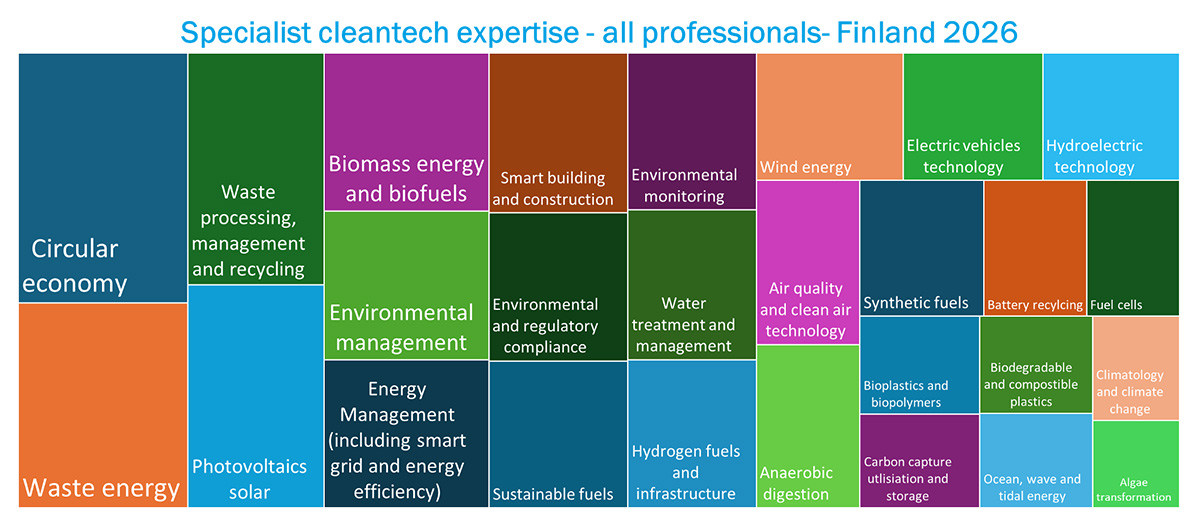
“Cleantech is evolving quickly. We see Finnish skills adapting to new technologies and sustainability challenges at pace,” says Lemagnen. Other significant areas include biomass, bioenergy, biofuels, renewable energy, environmental monitoring, energy management, and sustainable fuels.
Emerging niches are growing quickly, too. Expertise in electrification, energy storage, advanced environmental analytics and next-generation energy systems is expanding across the regions. These are exactly the technologies shaping global investment priorities.
Strong regional clusters
Cleantech expertise reaches far beyond Finland’s capital. While 36% of professionals live in the Helsinki capital region, significant clusters also emerge across the country. Northern Finland’s Oulu region accounts for 8% of the core resource, and the Vaasa–Kokkola region, a major European energy‑technology hub in the west, adds another 8%.
County-level maps reinforce the picture. Pockets of Cleantech specialization show up across the country, even in smaller regions. This reflects a national ecosystem where sustainability skills are embedded widely and not just in a few major centers.
“Technical talent is widely accessible throughout Finland. That accessibility is an important strength for employers,” Lemagnen notes.
A sector on the move
Cleantech in Finland is gaining momentum as advances in energy, circularity and climate technologies reshape global markets.
The TechSkillsAtlas™ 2026 study highlights a sector that is evolving quickly, supported by strong scientific capability, applied engineering expertise and well‑established regional strengths. It is an environment where new ideas can move rapidly from research to deployment.
“Cleantech skills in Finland are strong and evolving. The sector will continue to grow in importance as sustainability demands increase,” says Lemagnen.
For companies looking to develop or scale climate solutions, the message is strong. Finland offers the talent, the experience and the readiness to support ambitious Cleantech growth for today as well as the next wave of low‑carbon innovation.
TechSkillsAtlas™ Finland 2026
- TechSkillsAtlas™ is a technical skills measurement method created by MCJ Lemagnen Associates.
- The methodology was originally designed, tested, and developed by CEO Michel Lemagnen in 2006.
- MCJ Lemagnen Associates is a UK-headquartered, independent consulting and research firm, specializing in the fields of foreign direct investment and trade, economic development and research.
- The TechSkillsAtlas™ 2026 fieldwork in Finland was carried out by MCJ Lemagnen Associates’ Finnish and global fieldwork partner Verian, a division of one of the world’s largest insights companies.
- TechSkillsAtlas™ covers highly specialist technical skills, focusing on what people do now in their work and what they did in the past.
- Offers robust statistical information based on a quantitative, nationally and regionally representative web-based survey.
- 4,130 interviews conducted across mainland Finland; age range 18–64, including employed, self-employed and unemployed people. The survey excludes those in full-time education and individuals unable to work.
- The TechSkillsAtlas™ Finland 2026 was co-funded by Business Finland, Business Tampere and the Regional Council of North Karelia.