
Today, 178,000 people in Finland work directly in technical ICT roles. When you include those who have worked in ICT in the past – an enormous reservoir of “lapsed” expertise – the total rises to 394,000 individuals with ICT skills nationwide.
“This study shows that Finland isn’t just good at digital,” says Michel Lemagnen, CEO and co-founder of MCJ Lemagnen Associates. “It has digital depth in every corner of the country.”
And the numbers back him up.
Designed by the international consultancy MCJ Lemagnen Associates, the TechSkillsAtlas™ Finland 2026 study examines four key skills areas: ICT, Engineering, Healthtech, and Cleantech. The findings show that each sector is home to exceptional talent and specialist expertise, giving the country a technical edge few nations can rival.
The hidden ICT giant: Lapsed talent
For a nation of 5.6 million, this is extraordinary. Few technology hubs in the world can claim such a dense, skilled, and experienced digital population. Lemagnen describes it as “one of the strongest digital profiles we’ve measured.”
Among the lapsed ICT human resources, 52,000 people are currently unemployed, and many are in the early stages of their careers. Yet this isn’t a workforce that has turned its back on technology. The study finds that a strong share of unemployed lapsed professionals would return to technical roles, particularly if offered upskilling or retraining.
Lemagnen calls this a “strategic gift.” He notes, “The depth of the lapsed resource means Finland can respond to spikes in digital demand faster than many larger countries. The skills are there – they are just waiting to be reactivated.”
Interdisciplinary skills as standard
Software is Finland’s native language. According to the study, 81% of core ICT professionals have advanced programming skills – a remarkable share in any country.
This isn’t limited to one or two languages or frameworks. The underlying data spans 81 different programming languages and application frameworks, reflecting a workforce fluent in everything from classic enterprise systems to the newest tools shaping AI and automation.
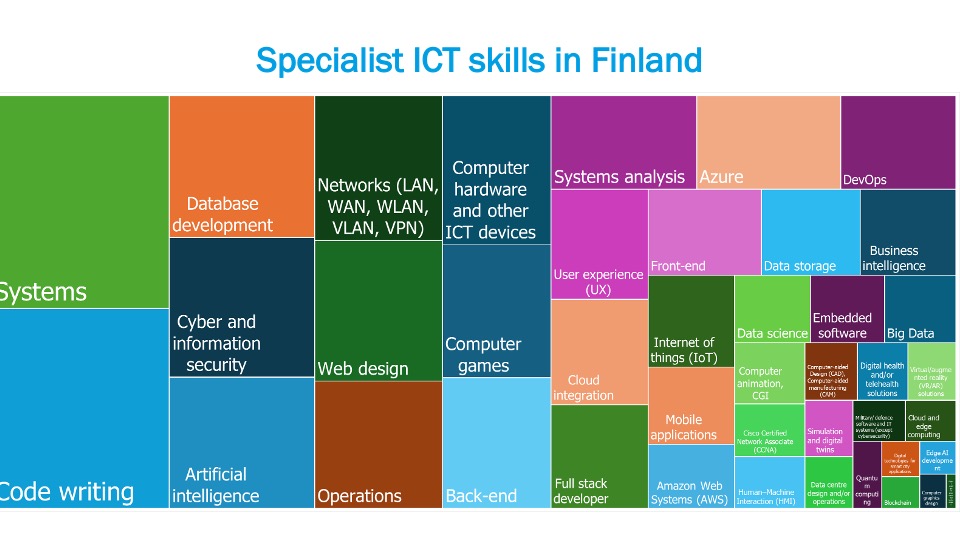
“When we first ran this study years ago, AI wasn’t even on the radar,” says Lemagnen. “Today it stands out as one of Finland’s most rapidly expanding areas of ICT expertise.”
Finland’s ICT community doesn’t work in isolation. Many ICT professionals report strong experience in engineering, Healthtech or other technical areas. This crossover is visible in fields such as digital health, industrial automation and smart energy systems – where software blends naturally with hardware, analytics and sustainability technologies.
Location-independent talent
The Helsinki capital region remains Finland’s digital hub. The southern region is home to two-fifths (42%) of all ICT professionals. But anyone who thinks Finnish ICT begins and ends there is missing the bigger story.
Western Finland, including the major regional hub of Tampere, accounts for another fifth (21%) of the workforce. And the study’s maps reveal notable concentrations across northern and eastern Finland, too. Even smaller counties show surprising pockets of ICT specialization, reflecting decades of investment in connectivity, education and research.
“Remote work is now a real feature of Finland’s ICT landscape,” says Lemagnen. “It’s helping make technical talent even more accessible across the regions.”
This geographic elasticity is one reason international companies view Finland as a scalable, low-friction location for digital operations.
Ready for the next wave of innovation
What the 2026 TechSkillsAtlas study brings into focus is a country that has quietly built one of the most resilient digital talent ecosystems anywhere and is still strengthening it.
The education pipeline keeps that engine running. Over three‑quarters of ICT professionals hold at least a bachelor’s degree, and Finnish universities and polytechnics produce more than 9,000 new ICT graduates every year. The skills stay fresh, the flow stays steady, and the pipeline stays strong.
New talent is fueling the rise of emerging technologies, while seasoned professionals provide the backbone for major corporate and public‑sector digital operations. It’s a combination that keeps the sector both innovative and resilient.
There is volume. There is youth. There is experience. There is advanced programming strength supported by world‑class education, research, and infrastructure. Regional accessibility and a culture of remote work make that talent available far beyond the big cities.
And then there is the lapsed resource: a vast community of professionals with real ICT experience, real capability and clear interest in returning to technical roles. Together, they give Finland a digital depth few countries can match. “Finland is in a very strong position,” Lemagnen says. “It has the digital skills for today and the capacity to grow for tomorrow.”