The talent engine behind Finland’s Healthtech edge
The TechSkillsAtlas™ 2026 study paints a picture of a Healthtech ecosystem on the rise. Finland has a technically advanced core workforce, a huge supply of new graduates, strong regional clusters and an unusually large reservoir of lapsed professionals who are willing and eager to return if the right roles appear.

Finland may not always be the first country named when discussing global health innovation, but the data says it should be. The TechSkillsAtlas™ 2026 study reveals a talent base that is far larger and far more sophisticated than many assume. With strong academic roots, deep interdisciplinary crossover and emerging specializations, Finland’s Healthtech scene is entering a new growth phase.
“Looking at areas such as medtech, biopharma, healthcare bioinformatics and digital health, it’s clear these are major growth priorities in Finland,” says Michel Lemagnen, CEO of MCJ Lemagnen Associates – the consultancy firm that authored the report. “Many new employment opportunities are emerging.”
Interdisciplinary power
One driver of these opportunities is Finland’s strong interdisciplinary overlap with engineering and ICT, especially in areas like bioinformatics, digital health, medical imaging, sensor technologies and data analytics.
This skills crossover allows Finland to excel in fast-evolving fields such as AI-driven diagnostics, wearable devices, telehealth platforms, and personalized medicine. It also accelerates collaboration between pharma, medtech, digital health, and academic research centres.
“Digital health is obviously underpinned by IT tech,” Lemagnen says. “And Healthtech professionals in Finland tend to have very good technical know-how in other fields too.” These specialist areas include bioinformatics, neuroscience, clinical trials, genetics, medical devices, microbiology, and advanced diagnostics.
The lapsed resource: A sleeping giant
The Healthtech sector in Finland currently includes 66,000 people working in technical roles across the country – a significant number for a sector built on long, specialized training cycles. In total, 7% of Finland’s workforce has technical Healthtech skills, but only a fraction works in the field today.
A large pool of 119,000 people forms the lapsed resource: individuals who have skills but are no longer employed in Healthtech roles. The wider study shows that a considerable share of the 9,000 unemployed technical professionals across all skills areas are interested in returning to technical roles, especially when supported with upskilling.
“Healthtech professionals are not easily replaced,” says Lemagnen. “Their training takes many years, their knowledge is highly specialized, and much of their experience is rooted in laboratory work, clinical environments and regulated development processes.”
Opportunity in transition
Finland’s Healthtech employment patterns differ from those of the ICT, Engineering and Cleantech sectors. The study found that only 43% of Healthtech professionals work in the private sector, while public and not-for-profit employers play a much larger role than in engineering or ICT.
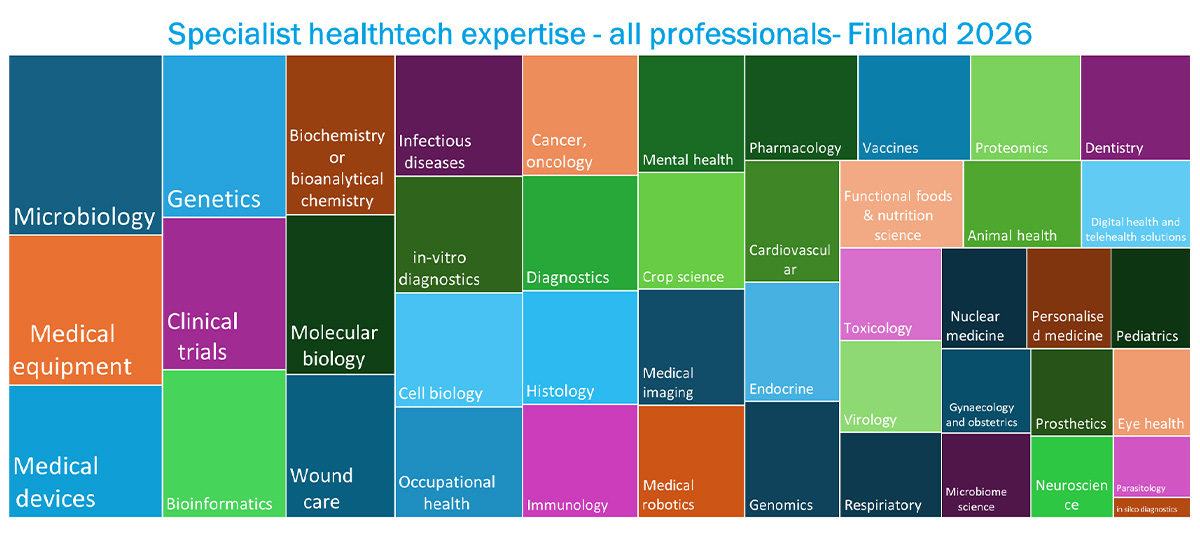
This structure creates both challenges and opportunities. Public-sector hiring constraints can push qualified professionals into other sectors – feeding the lapsed resource phenomenon. But as Healthtech industries expand into digital therapeutics, genomics, medtech manufacturing, and bio-AI, new private-sector opportunities continue to emerge.
Finland is well-positioned to capture this transformation. Its deep scientific talent, interdisciplinary strengths, national health data infrastructure, and strong university–industry collaboration ecosystem give it a natural edge. This academic strength carries directly into the Healthtech workforce itself.
Where science meets practicality
According to the study, 79% of Healthtech professionals hold at least a bachelor’s degree. And the workforce is balanced between emerging specialists and seasoned practitioners – half are aged 18–34, and 35% are 35–54.
Experience levels tell the same story. Almost half (49%) of the workforce has less than five years of Healthtech experience, while a solid 31% have more than ten years behind them. This mix delivers both innovation and stability.
Finland’s education system also continues to supply new expertise. Each year, Finland produces over 30,400 graduates from health and wellbeing programs across its universities, polytechnics and vocational tracks – and that talent spreads across the country.
A national network of talent
The TechSkillsAtlas™ 2026 study shows Healthtech talent is well distributed. Thirty-nine percent live in the Helsinki capital region, the country’s biggest life-science hub. But the south and west are also strongly represented. Twenty-seven percent live in the Southern Finland region, and Turku – with its biotech and pharma ecosystem – accounts for 13% of the core resource.
Tampere, a major hub in central Finland, and Oulu in the north are significant centers as well, particularly in areas like digital health and applied medical technologies. Kuopio in Eastern Finland further illustrates how Healthtech expertise extends beyond the largest cities, highlighting maturity across the entire territory.
“Finland’s Healthtech talent is spread more widely than people think,” Lemagnen notes. “It’s accessible, and it’s ready.”
Ready for what comes next
Healthtech in Finland is benefiting from rapid advances in digital health, personalized medicine and diagnostics. Thanks to strong science, data infrastructure, and engineering know‑how, companies can build teams covering everything from biology to clinical validation within a single region.
For companies seeking talent, Finland offers a rare mix of scale, quality and flexibility. It has depth, youth, experience, and interdisciplinary strength. And it has one of the largest pools of reactivatable scientific expertise in any technical sector in the study. Unquestionably, Healthtech in Finland is growing and accelerating.
TechSkillsAtlas™ Finland 2026
TechSkillsAtlas™ is a technical skills measurement method created by MCJ Lemagnen Associates. The methodology was originally designed, tested, and developed by CEO Michel Lemagnen in 2006. MCJ Lemagnen Associates is a UK-headquartered, independent consulting and research firm, specializing in the fields of foreign direct investment and trade, economic development and research.
The TechSkillsAtlas™ 2026 fieldwork in Finland was carried out by MCJ Lemagnen Associates’ Finnish and global fieldwork partner Verian, a division of one of the world’s largest insights companies. TechSkillsAtlas™ covers highly specialist technical skills, focusing on what people do now in their work and what they did in the past and offers robust statistical information based on a quantitative, nationally and regionally representative web-based survey.
4,130 interviews were conducted across mainland Finland; age range 18–64, including employed, self-employed and unemployed people. The survey excludes those in full-time education and individuals unable to work.
The TechSkillsAtlas™ Finland 2026 was co-funded by Business Finland, Business Tampere and the Regional Council of North Karelia.
More information
Interested in finding out how Finland could support your company's growth?
Invest in Finland, part of Business Finland, helps international companies establish and grow their operations in Finland. Contact our industry experts to discuss the opportunities for your business and to get started.